
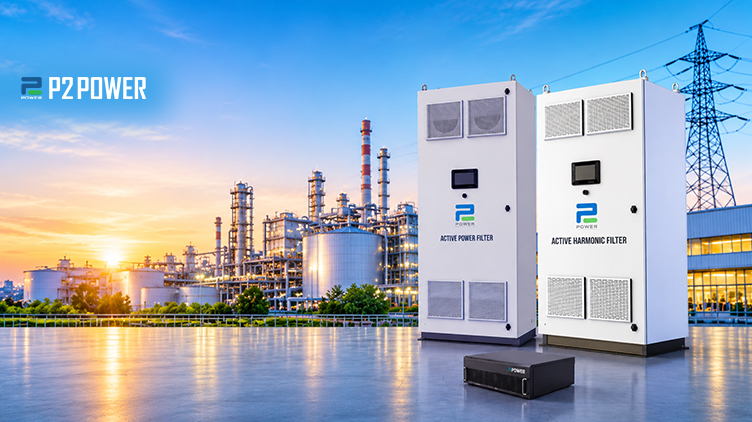
Maintaining good power quality is essential for the reliable and efficient operation of modern electrical systems. Industrial facilities, commercial buildings, and infrastructure projects increasingly use electronic equipment and power electronic devices that can introduce harmonics, reactive power demand, and other power quality disturbances into electrical networks.
Active Harmonic Filters (AHF) and Active Power Filters (APF) are widely used power quality solutions that help address these challenges. Although these terms are sometimes used interchangeably, their application and compensation capabilities may vary depending on the system configuration and technology.
What Is an Active Harmonic Filter (AHF)?
An Active Harmonic Filter (AHF) is an advanced power electronic device designed primarily to reduce harmonic distortion in electrical distribution systems.
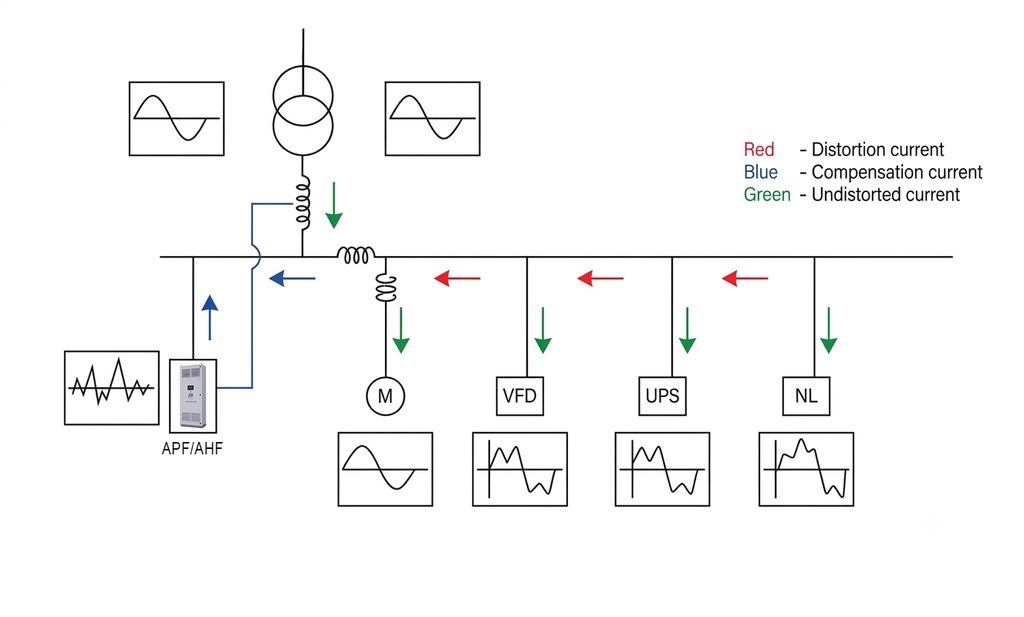
Harmonics are unwanted frequency components present in electrical current or voltage waveforms. They are commonly generated by nonlinear electrical loads, including variable frequency drives (VFDs), rectifiers, UPS systems, switching power supplies, and other electronic equipment.
Excessive harmonic distortion can lead to several operational problems, such as:
- Overheating of transformers, motors, and electrical cables.
- Increased power losses and reduced system efficiency.
- Unwanted tripping of circuit breakers and protective devices.
- Interference with sensitive electronic equipment.
- Reduced reliability and increased maintenance requirements.
An AHF continuously monitors the electrical current and identifies harmonic components. Using power electronic converters and advanced control algorithms, it injects compensating currents into the electrical network to counteract the unwanted harmonics.
This process helps improve the current waveform and reduce Total Harmonic Distortion (THD), supporting more reliable electrical system operation.
What Is an Active Power Filter (APF)?
An Active Power Filter (APF) is a power electronic solution designed to improve electrical power quality by dynamically compensating for unwanted current components in an electrical network.
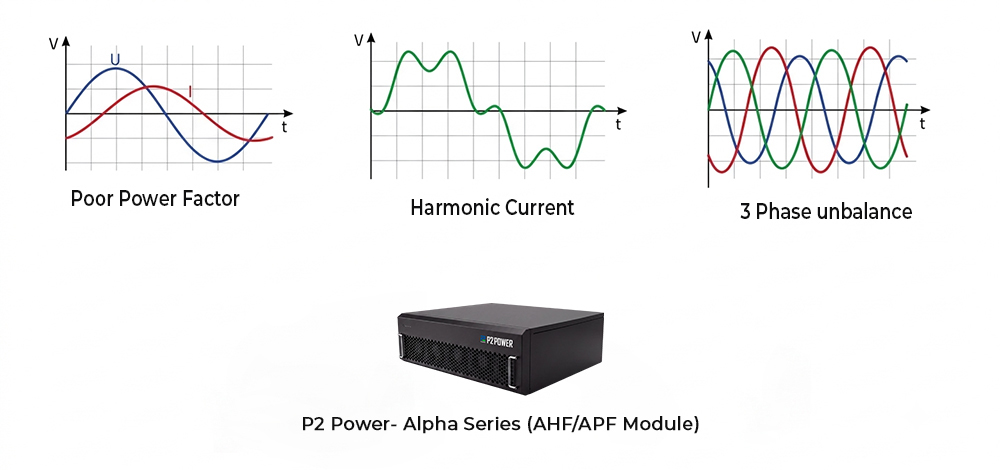
Depending on its configuration and control capabilities, an APF can perform multiple compensation functions, including:
- Harmonic current mitigation.
- Reactive power compensation.
- Power factor improvement.
- Load current balancing.
- Neutral current compensation in suitable configurations.
An APF operates by continuously measuring electrical parameters and calculating the compensating current required to address identified power quality problems.
It then generates and injects an appropriate compensating current into the electrical system. This helps reduce unwanted current components, improve the power factor, and maintain a more balanced and sinusoidal current waveform.
APFs are particularly useful in industrial and commercial installations where nonlinear loads, changing load conditions, and reactive power demand affect electrical system performance.
Note: A conventional shunt APF primarily addresses current-related power quality problems. Voltage disturbances such as voltage sags, swells, and interruptions generally require dedicated solutions such as Dynamic Voltage Restorers (DVRs) or Active Voltage Conditioners (AVCs).
Active Harmonic Filter vs Active Power Filter: What Is the Difference?
AHF and APF technologies share a common operating principle: using power electronics to inject compensating currents into an electrical network.
The primary distinction is generally related to terminology, product configuration, and compensation capabilities rather than two entirely separate technologies.
Here is a comparison of their typical applications:
| Comparison Parameter | Active Harmonic Filter (AHF) | Active Power Filter (APF) |
|---|---|---|
| Primary objective | Harmonic current mitigation | Overall current-related power quality improvement |
| Harmonic compensation | Yes | Yes |
| Reactive power compensation | Depending on configuration | Depending on configuration |
| Power factor improvement | With suitable compensation capability | With suitable compensation capability |
| Load balancing | Product-dependent | Product-dependent |
| Neutral current compensation | Product-dependent | Product-dependent |
| Typical application | Harmonic-intensive electrical systems | Industrial and commercial power quality applications |
In practical applications, an AHF may offer the same compensation functions as an APF. Therefore, selecting the right equipment should not depend only on its product name.
A detailed assessment of the electrical load, harmonic spectrum, reactive power requirement, system voltage, and compensation objectives is necessary before choosing an appropriate solution.
Which Industries and Facilities Need an AHF or APF?
Active filters are particularly beneficial in installations where nonlinear loads, harmonic distortion, and reactive power demand affect electrical system performance.
Some of the major applications include:
1. Industrial Manufacturing Facilities
Manufacturing plants frequently operate equipment such as variable frequency drives, industrial rectifiers, welding machines, induction furnaces, and automated production systems.
These nonlinear loads can introduce significant harmonic currents into the electrical distribution network.
Installing an appropriate AHF or APF can help reduce harmonic distortion, improve power factor where required, minimize electrical losses, and enhance the reliability of industrial equipment.
2. Commercial Buildings and Data Centers
Large commercial buildings, shopping complexes, IT facilities, and data centers operate numerous electronic devices, including servers, UPS systems, LED lighting, HVAC equipment, and computer networks.
These loads can contribute to harmonic distortion and other power quality concerns.
Active power filtering solutions help improve electrical system performance, protect sensitive equipment from current-related disturbances, and support reliable operation of critical infrastructure.
3. Renewable Energy Installations
Solar power plants and wind energy projects use power electronic inverters to convert generated electricity into a form suitable for grid connection.
Depending on the inverter technology and operating conditions, these systems may contribute to harmonic distortion and reactive power requirements.
Active filtering and compensation solutions can help manage these power quality challenges and support compliance with applicable grid and power quality requirements.
4. Hospitals and Healthcare Facilities
Hospitals rely on sensitive medical equipment, diagnostic systems, imaging machines, UPS installations, and critical electrical infrastructure.
Poor power quality can affect the reliability and performance of electrical equipment.
AHF and APF solutions can help reduce harmonic currents and address reactive power requirements, contributing to improved electrical system reliability in healthcare facilities.
5. Railways, Metro Systems, and Infrastructure
Railway and metro infrastructure involves traction systems, converters, auxiliary power supplies, and other power electronic equipment.
These applications can create harmonic distortion and reactive power challenges in electrical networks.
Appropriately designed power quality solutions can help manage these disturbances, improve electrical performance, and support reliable infrastructure operations.
How to Choose the Right Active Filter for Your Facility?
Choosing between an Active Harmonic Filter and an Active Power Filter requires an understanding of the electrical system and its specific power quality requirements.
Before selecting a solution, consider the following factors:
- Harmonic Analysis: Identify the harmonic spectrum, individual harmonic levels, and Total Harmonic Distortion (THD) in the electrical network.
- Reactive Power Requirements: Evaluate the reactive power demand and determine whether additional compensation is necessary to improve the power factor.
- Load Characteristics: Understand the type, capacity, and operating pattern of nonlinear loads connected to the system.
- System Configuration: Consider the electrical voltage, load capacity, transformer configuration, and available installation space.
- Future Expansion: Account for potential increases in electrical loads and future capacity requirements.
A professional Power Quality Audit and detailed harmonic analysis can help identify the root causes of electrical disturbances and determine the most suitable compensation technology.
Conclusion
Active Harmonic Filters and Active Power Filters play an important role in improving electrical power quality across industrial, commercial, and infrastructure applications.
While AHF is commonly associated with harmonic mitigation, APF is a broader term often used for active compensation technologies that can address harmonics, reactive power, and other current-related power quality problems.
Since their capabilities can overlap, the most appropriate solution should be selected based on actual electrical system requirements rather than terminology alone.
P2 Power provides advanced power quality solutions designed to address harmonic distortion, reactive power demand, and electrical system performance challenges. With appropriate power quality assessment and application-specific engineering, industries can improve electrical efficiency, equipment reliability, and overall system performance.
FAQs
1. Is an Active Harmonic Filter the same as an Active Power Filter?
AHF and APF are closely related technologies that use power electronic converters to inject compensating currents into electrical networks. In many applications, the terms are used interchangeably, although their actual compensation capabilities depend on the product design and configuration.
2. How does an Active Harmonic Filter work?
An Active Harmonic Filter continuously monitors the electrical current, detects unwanted harmonic components, and injects compensating currents in the opposite phase. This reduces harmonic distortion and improves the current waveform.
3. What are the main benefits of installing an Active Power Filter?
The major benefits include:
- Reduced harmonic distortion.
- Improved power factor, where supported.
- Reduced electrical losses.
- Improved load balancing.
- Lower equipment overheating.
- Enhanced electrical system reliability.
4. Can an Active Harmonic Filter improve power factor?
Yes, an Active Harmonic Filter can improve power factor if it has reactive power compensation capabilities. However, this functionality depends on the filter’s design, control settings, and available capacity.
5. Which industries require Active Harmonic Filters?
Active Harmonic Filters are commonly used in automotive, steel, cement, textile, pharmaceutical, FMCG, data centers, hospitals, renewable energy installations, and other facilities operating nonlinear electrical loads.
6. Can an Active Power Filter reduce Total Harmonic Distortion (THD)?
Yes. An Active Power Filter reduces harmonic currents by injecting compensating currents into the electrical network. This helps reduce current THD and improve overall power quality.
7. What is the difference between an Active Power Filter and a Passive Harmonic Filter?
An Active Power Filter uses power electronic converters and control algorithms to dynamically compensate for harmonic currents. A Passive Harmonic Filter uses combinations of inductors and capacitors to mitigate selected harmonic frequencies. Active filters are generally more adaptable to changing load conditions.
8. What causes harmonic distortion in industrial electrical systems?
Harmonic distortion is mainly caused by nonlinear loads such as VFDs, UPS systems, rectifiers, welding machines, switching power supplies, and industrial converters. These devices draw non-sinusoidal current from the electrical network.
9. How do I select the right Active Harmonic Filter for my industry?
Selection depends on the electrical load, harmonic spectrum, current THD, system voltage, reactive power requirements, and future load expansion. A detailed Power Quality Audit helps identify the appropriate filter capacity and configuration.
10. Can Active Harmonic Filters be installed in existing electrical panels?
Yes. Active Harmonic Filters can generally be integrated into existing electrical distribution systems. However, installation requires an assessment of available space, electrical ratings, CT locations, system configuration, and load characteristics.
Leave a Reply